Designing an AI-powered Business OS.
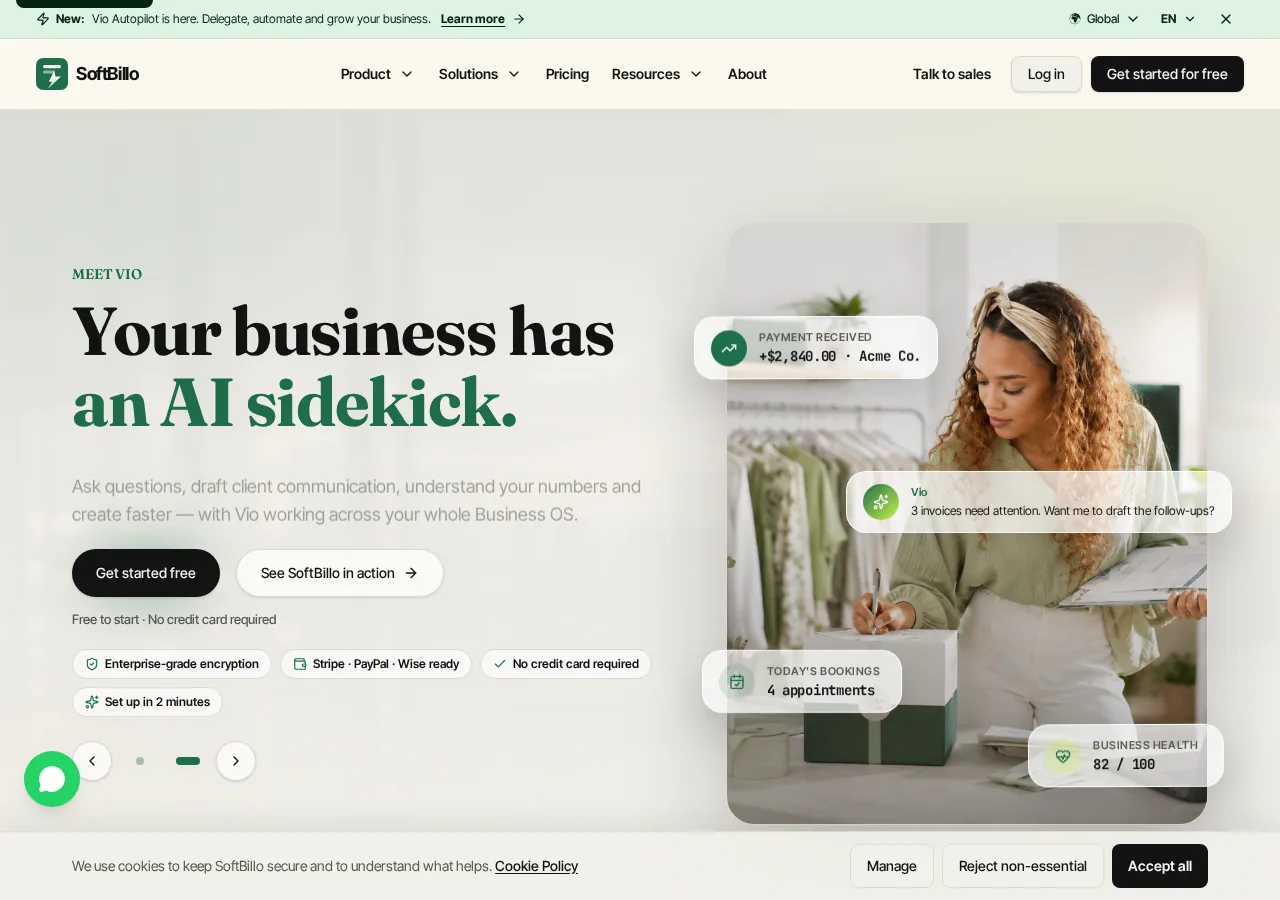
One connected workspace for freelancers, independent professionals, service businesses and SMEs to coordinate clients, bookings, invoices, payments, documents, projects and business reporting.
“Small-business owners should spend more time building their businesses and less time managing disconnected software.”
- Platform
- Web application
- My role
- Founder, Product Designer, Product Strategist and AI Product Lead
- Stage
- Live MVP with continued development and validation
- Audience
- Freelancers, independent professionals, service businesses and SMEs
The problem was not a shortage of software. It was disconnection.
Running a small business means finding and managing clients, scheduling appointments, creating invoices, tracking payments, organising documents, managing projects and remembering follow-ups. Existing tools often separate these responsibilities.
Information becomes scattered, work is repeated manually and financial visibility becomes harder to maintain. I identified an opportunity to bring essential operations together without overwhelming the person running the business.
Understand what is happening
Let business records work together
Make the next action visible
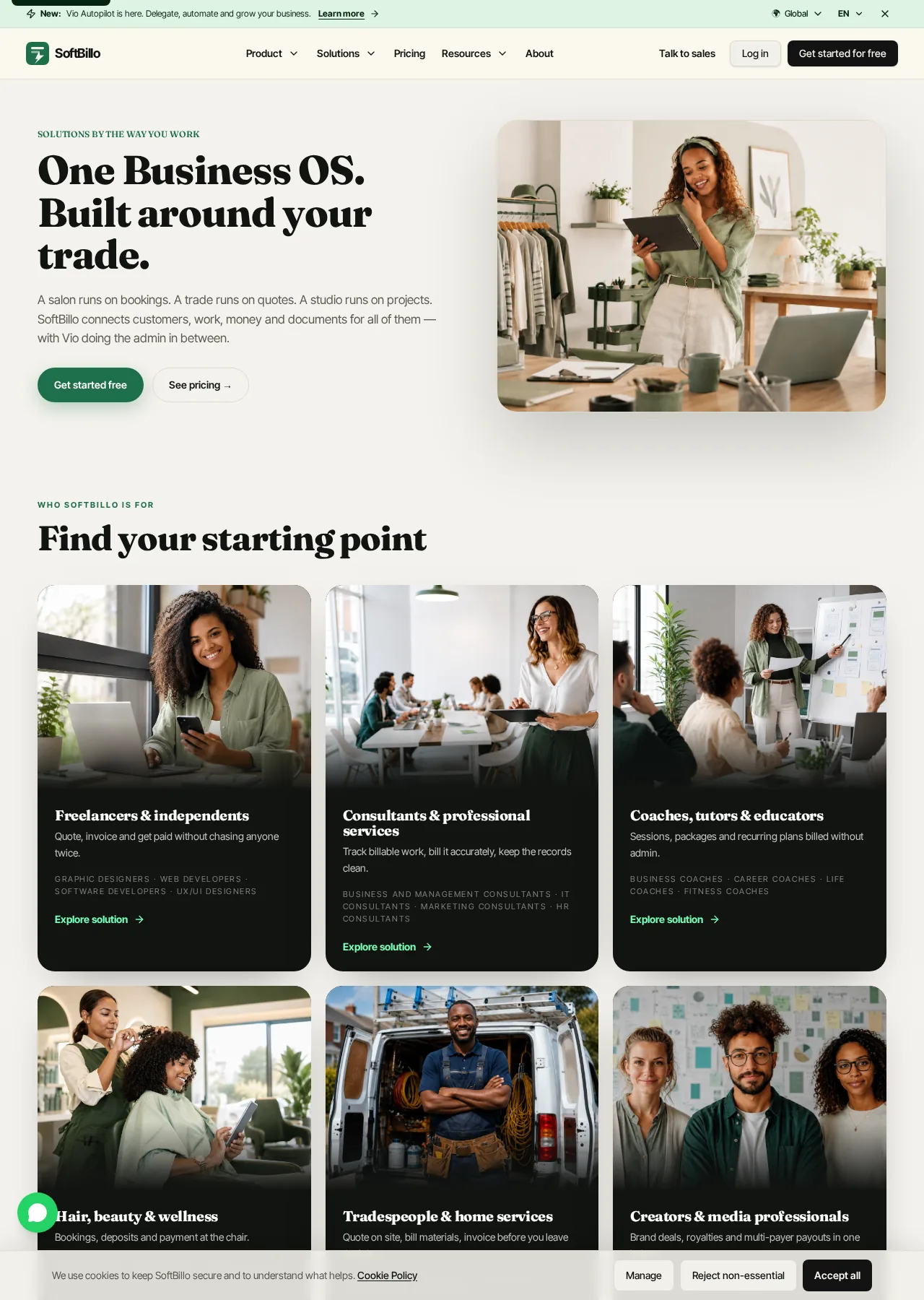
Different businesses. A shared need for organisation.
Four representative personas helped test the breadth of the proposition. They are product models, not presented as interview participants.
The freelancer
Needs one place for invoices, projects, payments and client information.
The business owner
Needs oversight of customers, transactions, bookings and daily tasks.
The service professional
Needs reliable bookings, customer records, reminders and follow-up.
The boutique owner
Needs a clear view of products, customers, payments and expenses.
Design the workflow, not a collection of features.
A customer can discover a business, book a service, enter its client record, receive an invoice, make a payment, complete an appointment and later receive a review request. From the user’s perspective, that is one journey.
- 01Discovery
- 02Booking
- 03Client record
- 04Service delivery
- 05Invoice
- 06Payment
- 07Review
- 08Repeat business
Specialised modules. One coherent system.
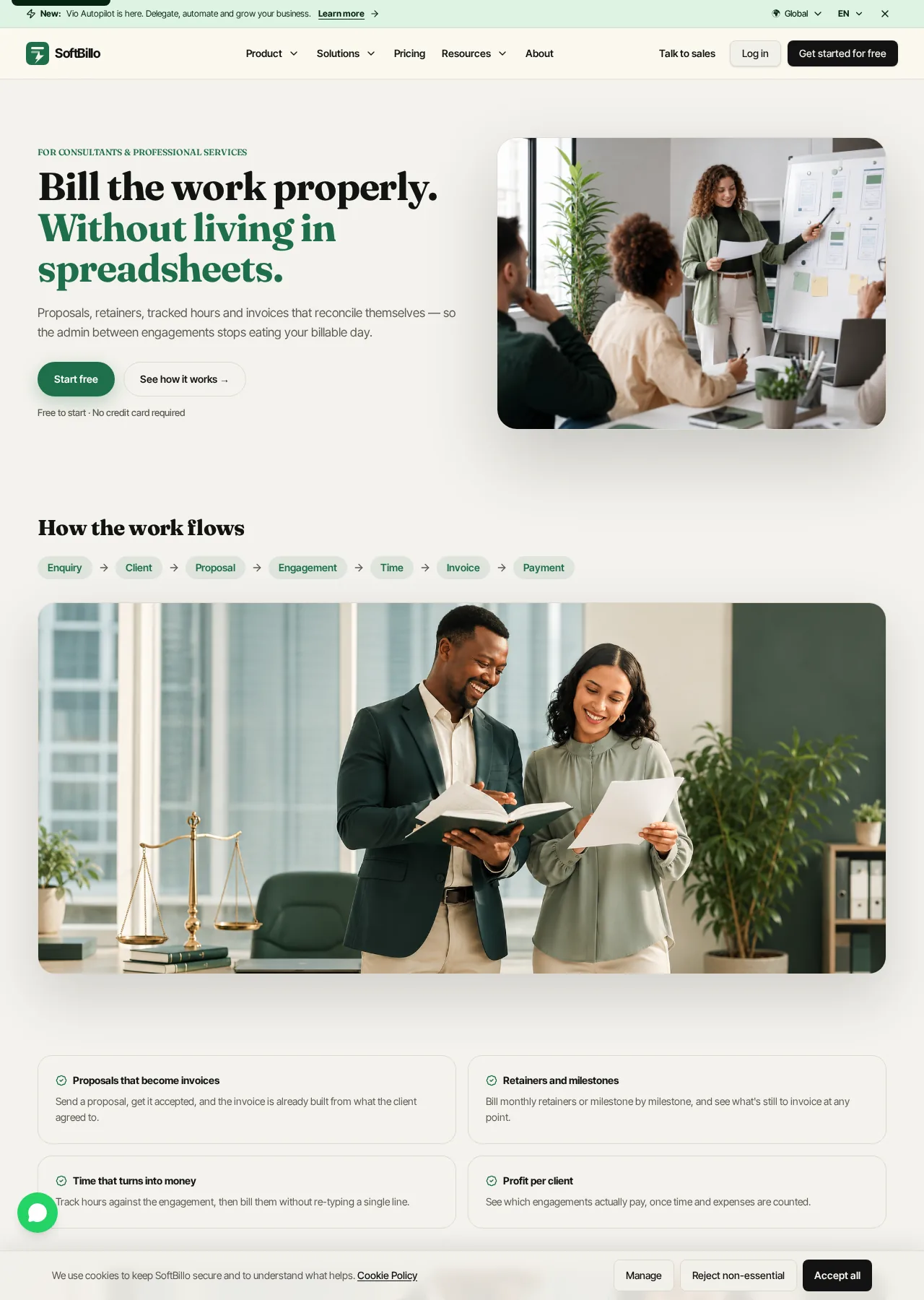
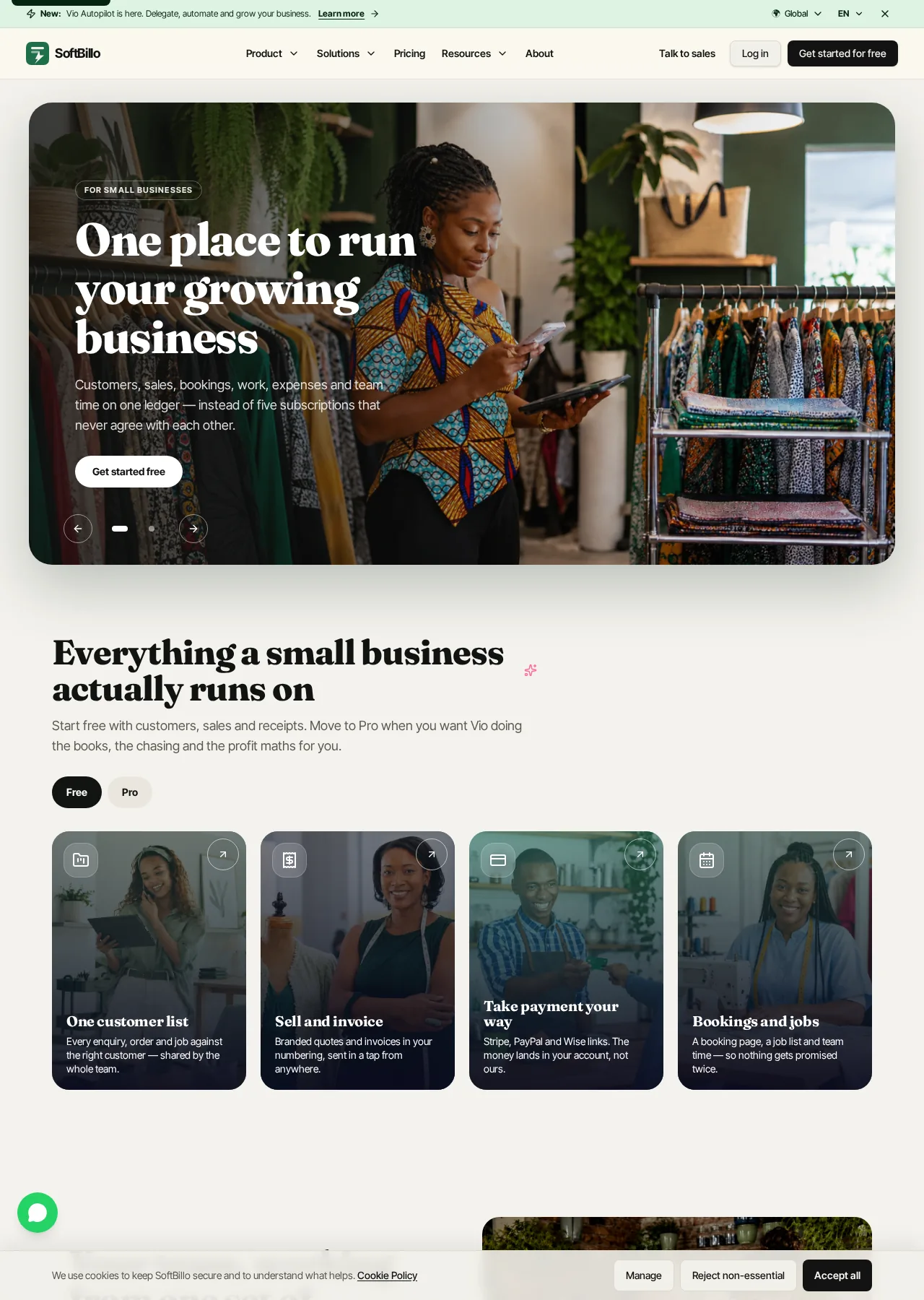
I organised SoftBillo into connected modules, while controlling scope around frequent workflows rather than trying to reproduce every enterprise feature.
Capability without dashboard complexity.
I approached the dashboard as a command centre rather than a menu of modules. The hierarchy prioritises important actions, upcoming bookings, outstanding invoices, recent payments, client activity, performance and AI recommendations.
Every screen is intended to answer three questions: What is happening? What needs attention? What should happen next? Primary actions receive visual priority while secondary detail is progressively disclosed.
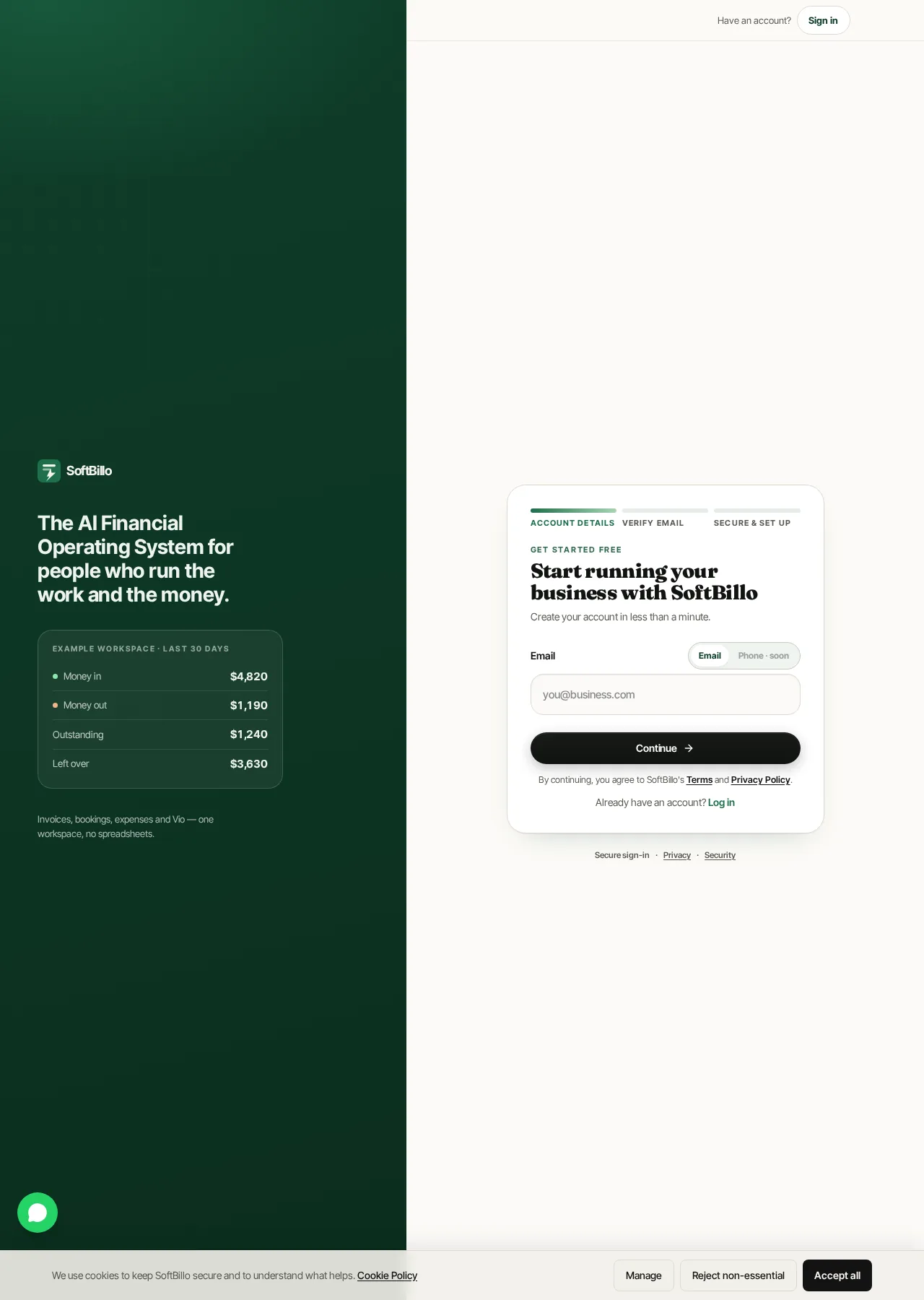
Onboarding for relevance
The onboarding direction gathers business type, size, priorities, currency and required tools so the workspace can become relevant instead of presenting every user with the same dashboard.
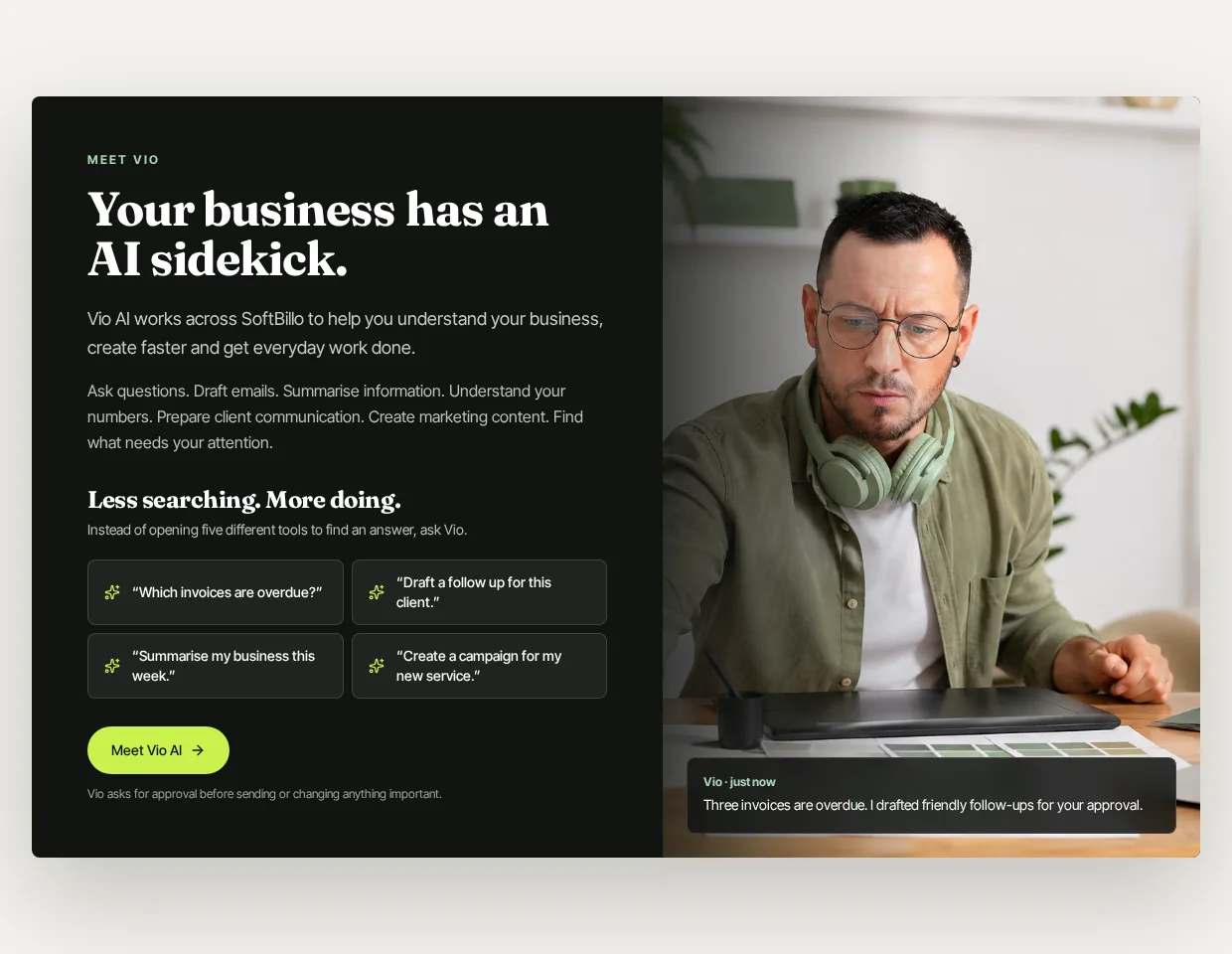
AI that works across the business context.
Vio is designed as an intelligence layer across SoftBillo, not a detached chatbot. Its direction includes summarising activity, highlighting overdue invoices and missed follow-ups, drafting communication, extracting document information and recommending next actions.
Prioritisation became part of the design.
As a solo founder, I was responsible for product direction, user experience, brand identity, feature prioritisation and AI strategy. Every idea had to answer one question: does this make running a small business meaningfully simpler?
Automation also had to remain understandable. AI-generated actions need confirmation states, activity histories and explanations so that users retain control.
A live MVP and a coherent foundation.
The project moved from an initial business-management concept to a live web application with a defined product architecture, user experience, brand system and AI direction. The central outcome is a system in which previously disconnected activities can become one understandable workflow.
What the next validation cycle should measure
No unverified usage or commercial result is claimed here. The ongoing validation plan focuses on observable behaviour:
- Onboarding completion
- Time to first invoice
- Time to first booking page
- Active clients added
- Bookings completed
- Multi-module adoption
- Administrative time saved
- AI recommendations accepted
- Retention
- Customer satisfaction
Simplicity is an active product decision.
The work reinforced that small-business complexity often comes from fragmentation, product architecture should reflect real workflows, and AI becomes more useful when it understands context across the product.
“Good product design does not begin by asking how many features can be added. It begins by asking how much unnecessary work can be removed.”
The most important limitation is breadth: a Business OS can become too broad before its core journeys are proven. The next phase therefore focuses on structured testing and stronger validation of the connected workflows.